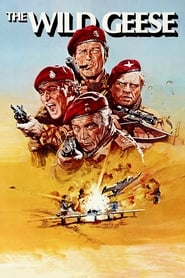
A group of retired soldiers are hired to rescue an African president in this action-packed film. The team, known as “the Wild Geese,” face numerous obstacles and danger on their mission. Their loyalty is put to the test as they navigate through treacherous terrain and fight against enemy forces. With non-stop action and intense suspense, “The Wild Geese” is a thrilling adventure that keeps viewers on the edge of their seats until the very end.
CLICK HERE⭭⭭⭭✅_Watch The Wild Geese 1978 English Subtitles_
Review
The Courage to Rebel: Lessons from “The Wild Geese” Movie
I have a confession to make: I love action movies. The kind of movies with guns, explosions, and heroes who defy death and authority to save the world or their loved ones. Yes, they often promote violence and simplistic solutions to complex problems, but they also provide a cathartic escape from reality and a source of inspiration for challenging norms and pursuing justice. That’s why I want to talk about “The Wild Geese”, an underrated gem from the 70s that combines adrenaline with heart, humor, and humanity.
At first glance, “The Wild Geese” seems like a typical mercenary movie: a group of aging soldiers-for-hire is hired by a ruthless businessman (played by Stewart Granger) to rescue an African leader (played by Winston Ntshona) who is trapped in a rebel-held prison. Led by the charismatic Colonel Allen Faulkner (played by Richard Burton), the team faces numerous obstacles on their way to the mission, including treacherous allies, hostile enemies, and inner demons. However, as the plot unfolds, we discover that “The Wild Geese” is much more than an action flick; it’s a story about courage, loyalty, honor, friendship, and sacrifice.
Throughout the movie, we see how each member of the team has his own motivations for joining the mission. Some are in it for money or glory; others are driven by loyalty or revenge. Yet all of them share a common code of conduct that defines their identity as soldiers. They value competence over rank; they trust each other more than their clients or governments; they stick together even when facing impossible odds; and they never leave anyone behind or betray any secrets. These values not only make them efficient soldiers but also enable them to form deep bonds with each other that transcend race, nationality, religion or ideology.
For example, when the team arrives in Africa, they meet the local rebels who are fighting against the corrupt government and its foreign supporters. The rebels are led by a fierce woman named Shawn Fynn (played by Barbara Hershey), who initially regards the mercenaries as arrogant and insensitive. However, as she sees them in action and learns more about their backgrounds and struggles, she develops a grudging respect for them and even joins their cause. She tells Faulkner: “I understand now why you fight…It’s not just for money or fame or pleasure…It’s because it’s your way of saying ‘I am’. And nobody can take that away from you.”
This quote captures one of the main themes of “The Wild Geese”: the importance of self-expression and self-respect. The mercenaries may be seen as outlaws by some standards, but they refuse to let anyone else define their worth or purpose. They choose to use their skills for what they believe is right, even if it means defying powerful institutions and risking their lives. They also respect other people’s choices to do the same, as shown by their interactions with Fynn, Ntshona’s character Limbani, and other African characters who have different views on politics and life.
Another theme that resonates with Brené Brown’s work is vulnerability. Although the mercenaries are tough and confident on the surface, they all have insecurities, doubts, regrets, and scars that haunt them. Some are haunted by past traumas such as war crimes or betrayal; others struggle with addiction or loneliness; still others face mortality or aging. Yet they don’t hide these vulnerabilities from each other; instead, they share them openly during moments of reflection or crisis. This helps them not only bond more deeply but also learn from each other’s experiences.
For example, when Faulkner discovers that one of his men has betrayed him to Granger’s character, he confronts him in a poignant scene that showcases Burton’s acting skills. He tells the traitor that he understands why he did what he did, as he also has “a weakness for the easy way out”. He admits that their mission is not just about saving Ntshona’s character but also about redeeming themselves from their past mistakes and finding a purpose beyond their own lives. He also forgives him for his betrayal but warns him that they won’t forget it and that they will still treat him as one of them until the end. This scene captures both the pain and the beauty of vulnerability: it exposes our flaws, but also invites us to connect with others on a deeper level by sharing our humanity.
The acting in “The Wild Geese” is top-notch, with Burton leading an impressive ensemble cast that includes Roger Moore, Richard Harris, Hardy Krüger, and Kenneth Griffith. Each actor brings depth and nuance to his role, creating characters who are more than just stereotypes or caricatures. Burton himself gives one of his most compelling performances as Faulkner, balancing his commanding presence with moments of introspection and humor. Moore plays a suave intelligence officer who provides some comic relief and thrills; Harris plays a tough medic who cares deeply for his comrades; Krüger plays a cynical pilot who learns to appreciate loyalty; Griffith plays a sly spy who uses his wits to save the day. Even Granger manages to infuse some charm into his villainous role, making us understand why he does what he does.
The score by Roy Budd is also noteworthy, blending epic orchestral sections with African rhythms and jazzy cues. The main theme is unforgettable, mixing military drums with haunting strings and brass motifs that capture both the heroism and the tragedy of war. The cinematography by Jack Hildyard effectively conveys both the beauty and ugliness of Africa, from lush jungles to desolate plains to grimy cities. The editing by John Glen, who would later direct several Bond movies, keeps the pace brisk but also allows the characters and themes to breathe. The special effects may look dated now, but they still serve their purpose of creating exciting and visceral set pieces that showcase the skills of the mercenaries.
“The Wild Geese” was not a box-office success when it was released in 1978, but it has gained a cult following over the years and inspired other movies such as “The Expendables”. It has also been criticized for glorifying mercenaries and perpetuating colonialist stereotypes about Africa. However, I think these criticisms miss the point of the movie: it’s not a political manifesto or a sociological treatise; it’s a story about people who struggle to find meaning, connection, and redemption in a world that often sees them as expendable. It’s about how courage can take many forms, not just the one that is sanctioned by authority or tradition. It’s about how rebellion can be a force for good, not just for chaos or oppression.
In conclusion, “The Wild Geese” is a movie that deserves more attention and appreciation than it has received. It offers both thrills and insights into human nature that can enrich our lives if we approach them with an open mind and heart. It shows us that courage is not just an attribute of superheroes or soldiers; it’s something that we all have within us, waiting to be unleashed when we dare to be vulnerable enough to show it. As Faulkner says to his team before they embark on their mission: “We fight because we’re men…We fight because we’re free…And we fight because we’re rebels!”
Technical Data

- Release : 1978-06-28
- Runtime : 134
- Genre : Action
- Cast : Roger Moore as Lt. Shawn Fynn, Richard Harris as Capt. Rafer Janders, Hardy Krüger as Lt. Pieter Coetze, Richard Burton as Col. Allen Faulkner, Stewart Granger as Sir Edward Matherson
- Crew : Reginald Rose as Screenplay, John Glen as Editor, Jack Hildyard as Director of Photography, Andrew V. McLaglen as Director, Daniel Carney as Novel
- Revenue : $9,884,149
- Budget : $11,600,000
- Company : Richmond Productions
- Popularity : 18.683
- Summary : A British multinational company seeks to overthrow a vicious dictator in central Africa. It hires a band of (largely aged) mercenaries in London and sends them in to save the virtuous but imprisoned opposition leader who is also critically ill and due for execution. Just when the team has performed a perfect rescue, the multinational does a deal with the vicious dictator leaving the mercenary band to escape under their own steam and exact revenge.
- Tagline :
